Back to: Foundations of Art
Lesson Objectives
- Identify and describe the types of lines
- Describe, analyze, interpret and judge a work of art.
Lesson Materials
- Paper
- Preferred marking tool (pencil, crayon, charcoal, etc.)
- Image from a magazine or found on the web
Lesson Standards
- NVAS #2 Using knowledge of structures and functions
- NVAS #5 Reflect on and evaluate the characteristics and merits of their works.
- NVAS #6 Making connections between the visual arts and other disciplines.
The term or element called line is a mark created by human beings on a surface. The artist Paul Klee once said, “A line is the trace of a point that went for a walk.” In mathematics it is defined as the movement of a point along a surface, which has neither width nor depth, but length. Other definitions found in dictionaries: “A short or long mark between two points” and “a stroke between two points in space”.
From a philosophical point of view, nature does not create lines. It is a human invention. Rather, it is the way we humans translate our visual world, in order to reproduce it in 2 and 3 dimensional media (more about 3D later). Anyway, lines are an invention that humans created to explain the phenomenon of an object’s surface ending at a point and another object’s surface beginning at the same point. On the other hand, the same thing happens when an object ends and space begins. This is what we also call the boundary or contour of the objects included in the conversation.
If we think of their physical state, the lines have no more than one dimension. They are only long. Once we can add width, it stops being a line and becomes a rectangle.
Let’s identify the types and names of lines.
Implied line:
An implied line in art is a line that is not intentionally marked, but other objects or elements are aligned so that they visually form a line.
Real line:
A real line is a mark made by the artist in the form of a line. Contours of objects, details of their surfaces and borders of areas are lines made by the artist. As said before, nature has no lines, only edges and surface borders. We can say that it does “align” certain things, but it does not create lines. Again, we are back to the human created concept where we call the edges or “borders” of the areas of objects as lines.
Lines can have different importance in different artworks. For example, they can have these uses:
- As “boundaries” or delimitations between objects.
- For example, like the fences around a property as seen from the sky.
- As implicit lines.
- These lines do not exist, but are formed with the eye by the aligned position (in line) of other elements and objects.
- As a surface tone.
- When drawn close to each other, the area becomes darker and the more space between the lines the “lighter” the tone of the surface of the art. Stippling, simple scratching and crosshatching are some of the methods used to create tone with lines.
- As surface texture.
- When drawing a tree you can create the texture of the trunk with crosshatching and other techniques to give a sense of texture to the trunk.
Line names
Horizontal, vertical, diagonal, are some of the names used to name, and in turn, describe, lines. When we begin our journey in art during elementary school we are taught names for lines. Some are childish like “Scribble Scrabble” and others follow us all our lives like horizontal, diagonal, vertical and curves.
When the concept of perspective was developed at the time of the Renaissance, the concept of horizon was discovered, probably named after the horizontal line we were already using. When we study the concept of perspective in art, vertical, horizontal and diagonal lines will be indispensable.
- Horizontal – very often classified as soft, peaceful and serene.
- Vertical – constantly used to denote strength, stability and charisma in art.
- Diagonal – commonly used to denote movement, as they give the impression of looking up or down in art.
- Curves – used to cause a sense of movement like diagonals but with more grace and serenity.
- Zigzag – often used to denote tension, terror, uncontrolled joy and other exaggerated emotions.
Optional Exercise
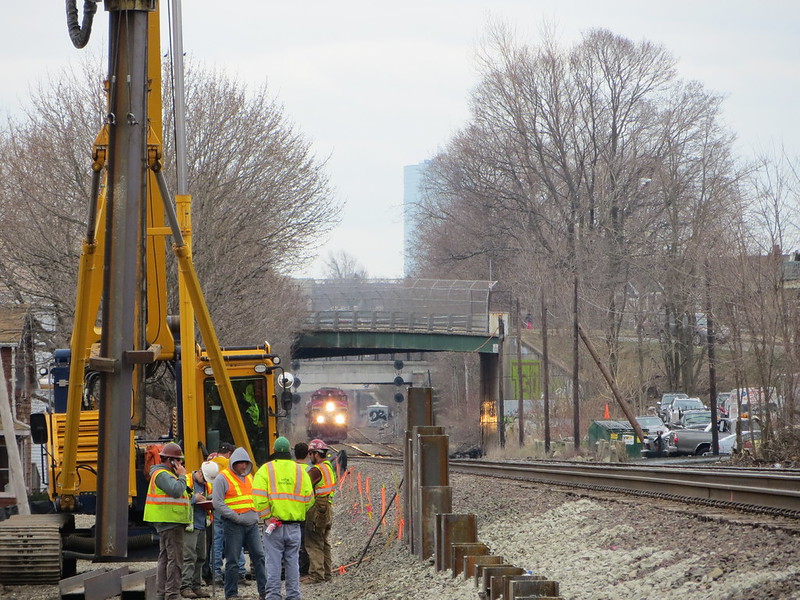
If desired, indicate where you see vertical, horizontal, parallel, curved or zigzag lines in this image of “Pile Driving Operation: South of the Harvard Street Bridge in Medford, MA.” (find more information here.)
Personal note:
Art masters throughout history have stated that drawing is the basis of all art forms. Despite being an opinion, this is accepted by a large number of artists. Everyone can draw. A personal anecdote I can share with you is something I used with my students when I was in the public teaching field. When a student indicated to me that they could not draw I would ask them to write their name. Once done, I would show them that all the letters and marks they made were line based and that is all that is necessary to draw. I would then explain that saying “I can’t draw” is a self-managing prophecy.
So, if you are ready for the adventure, grab, take or look for your pencil, marker, pen or any other instrument and let’s start drawing…